- New


 Delivery policy
(edit with the Customer Reassurance module)
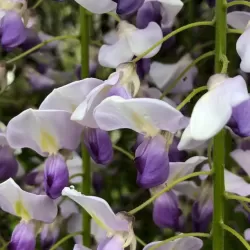
Wisteria Grande Diva® Nathalie is part of a new series of hybrid wisterias from W. brachybotrys (formerly W. venusta) called 'Diva' that combine their qualities. These varieties show rapid flowering, which occurs from the first years of cultivation, they bloom harmoniously and uniformly throughout their vegetation and do not damage their support. Much less vigorous than its Chinese and Japanese cousins, the 'Diva' wisteria can easily be maintained by pruning to smaller dimensions, making it suitable for a small garden or even a large pot on the terrace. This 'Nathalie' variety, the most flowered of the 'Grande Diva' range, in spring offers clusters of blue-mauve and white bicoloured, fragrant flowers on beautiful caramel and lime green foliage.
Wisteria Grande Diva® Nathalie is derived, among others, from a Japanese species of modest stature called the Silky or Graceful Wisteria. It is a small deciduous climber, whose foliage appears in spring and falls in autumn. As an adult, it will measure between 3 m and 10 m in height depending on how it is pruned and whether it is grown in the ground or in a container. Its twining stems bear leaves divided into 12 ovate leaflets, measuring 4 to 7 cm long. These stems twine from left to right (dextrorse) on solid supports. The abundant flowering takes place in May-June, at the same time as the young foliage unfolds, tinged with bronze caramel. It takes the form of pendulous clusters, 15-20 cm long, fragrant, composed of very bright bicoloured papilionaceous flowers, with blue-mauve petals and white petals. Hardy down to at least -20°C, the Wisteria Grande Diva Nathalie is easy to grow in any loose and deep soil, moist to occasionally dry.
The 'Grande Diva Nathalie' wisteria is perfect for dressing up a wall, railing, pergola, arbour, or porch in a romantic garden, including smaller ones. While wisteria branches are usually capable of twisting even the strongest trellises, this variety is much more "respectful" of the supports it grows on. It can also be planted in a container on a balcony or terrace. It pairs well with a Mayleen montana clematis, a Purpurea Plena Elegans clematis, or perennial peas.
Data sheet
You might also like